
South Africa’s art world is going through a powerful transformation. While galleries, fairs, and institutions remain important, artists are increasingly redefining how they work, who they work with, and how they reach audiences, often beyond traditional structures.
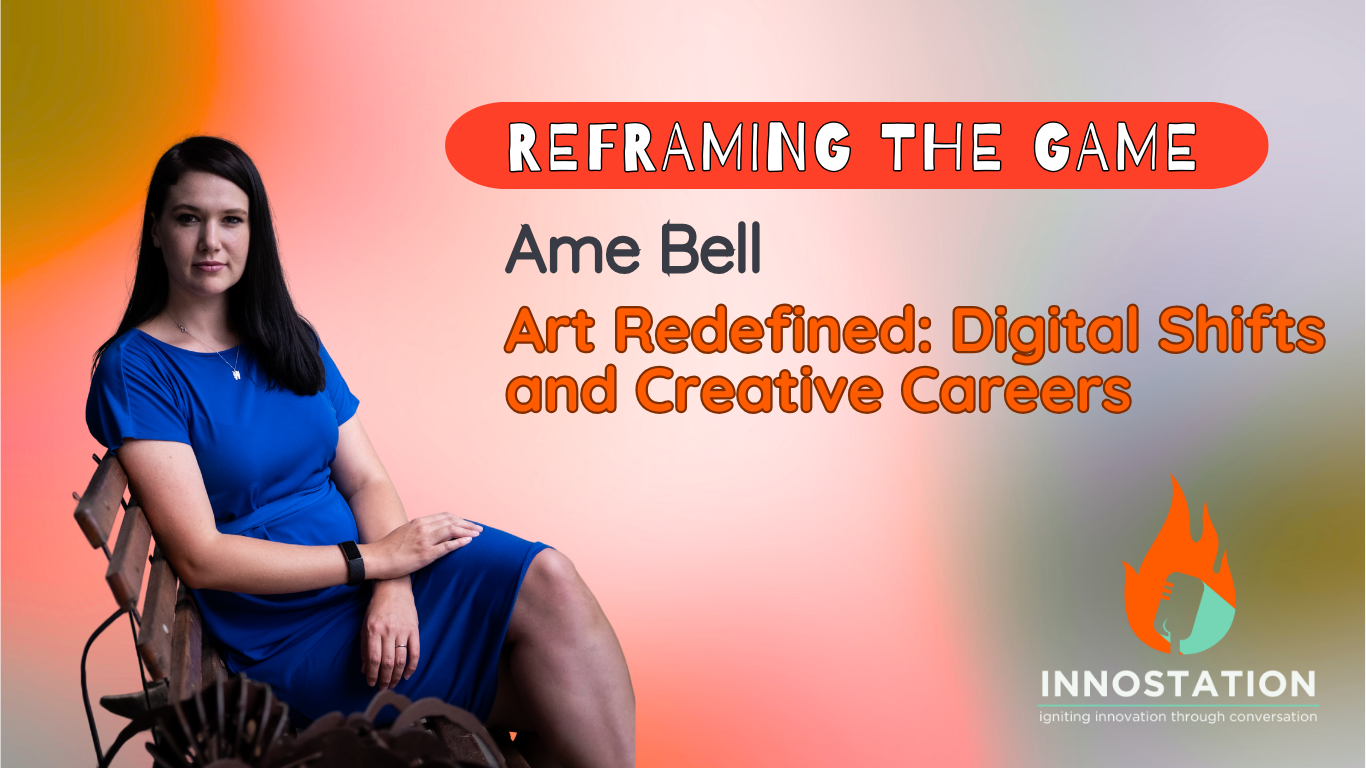
In this episode of InnoStation, host Kami Mojapelo speaks to Ame Bell, Director of David Krut Projects and newly graduated PhD in Art History, about how independent and private initiatives, digital platforms, and shifting mindsets are reshaping the local and global art ecosystem.
A front-row seat to change
Ame’s journey into the arts has been deeply personal and professional. An artist, curator, and researcher, she has spent years working closely with artists while studying how systems within the art world function. Her PhD research focused on independent and private initiatives in South Africa, with a particular emphasis on how the digital space enables artists to operate more autonomously.
For Ame, art is more than an object, it’s a way of making sense of the world. “Art has the ability to communicate across all borders,” she explains, describing it as resilient, rebellious, and deeply human.
Digital as an enabler, not a replacement
One of the central themes of the conversation is the role of digital tools in empowering artists. While websites and social media were once supplementary marketing tools, the COVID-19 pandemic accelerated their importance, turning digital platforms into primary spaces for visibility, connection, and income generation.
Artists now have access to tools that allow them to build audiences, document their processes, and negotiate relationships with galleries from a stronger position. This shift has altered traditional power dynamics and created greater flexibility across the sector.
As Ame notes, “We’re in the age of self-representation and self-publishing.” With access to technology, artists no longer need to wait for institutional validation to participate in the global art dialogue.
Art as a profession
The episode also explores the growing professionalisation of the arts. Ame challenges the idea that creative work is extracurricular, arguing instead that artists must be seen and supported as professionals and entrepreneurs.
Running an art practice today often means functioning as a project manager, business owner, educator, and collaborator. When art is treated as legitimate work, it strengthens the creative economy and opens doors to cross-industry collaboration, from tourism to advertising.
This shift, Ame suggests, is essential for creating sustainable careers in a sector where income is often unpredictable.
Preserving tactility in a digital world
Despite the rise of digital tools and AI, Ame emphasises the enduring importance of physical, tactile art. In response to screen saturation, many artists are producing slower, more labour-intensive work that highlights craftsmanship, materiality, and tradition.
From collage and fabric to printmaking and sculpture, these practices preserve cultural knowledge and human connection. Physical artworks, Ame explains, are the artefacts that will endure telling the story of our time long after digital platforms have evolved or disappeared.
In a hybrid future where digital and physical coexist, this balance becomes vital.
Listen to the episode
Links

Website: David Krut Projects
Transcript
Kami Mojapelo [00:00:04] – [00:00:42]
You’ve just tuned into Innostation, where the latest and hottest topics are always on air. I’m your host, Kami, and each episode we serve up heat with fun chats, fire insights and special guest appearances with a couple of surprises along the way. Now, the South African art scene is constantly evolving with new voices, new mediums, and new ways of seeing the world. In the spirit of redefining the game, we’re unpacking how the industry itself is shifting today. And joining us is someone who’s had a front row seat to these changes for years, Ame Bell, who is the director of David Krut Projects. Welcome to Innostation, Ame.
Ame Bell [00:00:42] – [00:00:45]
Hi, Kami, thanks so much for having me. It’s lovely being with you.
Kami Mojapelo [00:00:45] – [00:00:54]
Of course. Thank you for joining us. And before we go any further, you became a PhD graduate recently. Congratulations.
Ame Bell [00:00:54] – [00:01:00]
Thank you so much. I feel very chuffed with myself at the moment, but thank you.
Kami Mojapelo [00:01:00] – [00:01:08]
Yes, I caught your post on LinkedIn, I think like two days ago, and I was like, yeah, we need to call a doctor Ame, now.
Ame Bell [00:01:08] – [00:01:11]
That’s it. Yeah.
Kami Mojapelo [00:01:11] – [00:01:27]
So you’re an artist and as mentioned, you are the director of David Krut Projects in South Africa, and you’re also a true arts aficionado. What is it about the arts that drives you and what inspired you to pursue your PhD in art history?
Ame Bell [00:01:27] – [00:02:19]
Yeah, what is it about the art that drives me..? Wow. It is – at its essence, at its core, art has the ability to communicate across all borders, visible and invisible. But, it’s a way of making sense of the world. For me, it’s, it’s resilient, it’s rebellious. Maybe that’s one of the things that I like the most about art. In all its forms it feels like just the act of participating in art or reading about art is a rebellious act because it’s so against the grain of what is normal. Which is maybe a bit contradicting to what we want to talk about today. But I mean, that’s really, for me, what is so special about it. And I was thinking a lot about this in preparation for our call.
Ame Bell [00:01:27] – [00:02:19]
It just seemed to work.
Ame Bell [00:02:19] – [00:02:55]
You know, what is it? But it’s a feeling. Art is so close to my being as a whole. Ever since I was a child, I only read art books and loved looking at the pictures. And I’ve always wanted to be close to artists and their practices, which is really why I ultimately pursued my PhD in Art History because it’s just been kind of a natural trajectory for me through my education and my professional practice. And, it’s always just something that I wanted to do. There’s really no fancy answer to why I did a PhD.
Ame Bell [00:02:55] – [00:03:43]
And I really don’t want to be called a doctor because it’s not about that, it’s really just about understanding how systems work. And in the industry that I am in, I work with a lot of artists. And what was really interesting to me about the process was that I could actually structurally understand why things happen, the way that they happen, why artists do what they do. And it’s really enriched the way that you think about things. Because if you talk about industries we always try and make sense of what I do, real work type of thing. And doing the PhD actually just allowed me to formalise my thought process about why artists do what they do, how it all works, and where is my place, my role in all of that.
Ame Bell [00:03:43] – [00:04:10]
So that’s really what pushed me to do it and what enabled me to do it. I want to say, at the risk of it sounding the wrong way, but it’s what enabled me to do it kind of effortlessly is that my research was so ingrained in my every day, my every day practice and my work. So I just really love doing it, and won’t do it again. But yeah, I loved it.
Kami Mojapelo [00:04:10] – [00:04:40]
I love that answer because it just sounds so inspired. It genuinely sounds like you were just sort of letting your passion guide you through all of it. And I love that. And speaking of your PhD, your dissertation looked at Independent and private initiatives and how they reshaping the South African art landscape. From your research, why do you think that the shift is happening and what does it mean for our broader art ecosystem in the country?
Ame Bell [00:04:40] – [00:05:45]
So, my research was, as you said, focused really, it’s on independent artists, but it was really the role of the digital space, the Internet that enables them to function within the art world. And the thing is that they have artists and galleries – everybody since the COVID 19 pandemic, everybody went online. The entire industry had to go online because we were very reliant on personal contact, people coming to galleries and prior to Covid, people using websites and Instagram. So but in a very loose way, just as a supplementary marketing tool. But since then, because everyone had to go online, people really realised the strength that the digital space, as I call it in my research, has for producing content, putting yourself out there and really creating an autonomous practice. So galleries were doing certain things, they were putting shows online, they were putting information about artists and artworks online and artists recognised and they’re like, well I could do that.
Ame Bell [00:05:45] – [00:06:31]
And they started doing it themselves and they started showing parts of their process and all that. So a major shift has been caused by people realising the importance of digital. And I think you’ll agree in the last – definitely five years, there’s been a huge acceleration in digital technology, AI technology and all of that. So I mean the digital tools really democratise participation in the arts, allowing artists to really build audiences, networks and income streams from various platforms, social media. I mean we’re really in the age of self representation and self publishing, which has become so easy for everybody. And then if you think about it in the arts, an artist could have an Instagram page, they can ask AI to build them a website.
Ame Bell [00:06:31] – [00:07:24]
Skills that they didn’t need to necessarily have before or that they didn’t have are now accessible to them through programming. So this is not actually a further step from what I took in my research, but just how it’s grown and how it has accelerated is crazy. And then what’s happened in the art world is that these power dynamics are shifting between artists and galleries, artists, institutions, everybody that’s an agent – let’s say, in this art field they, artists are negotiating their positions in the art world from a kind of strengthened position through the presence that they have online. People already know about them, they may be selling work. So the way that they work with galleries is in a much more controlled position. They can make decisions. It’s also enabled them to be a lot more flexible.
Ame Bell [00:07:24] – [00:07:35]
And I think not only artists, but galleries and other institutions have had to be more flexible and have non exclusive arrangements because now we can work with multiple people.
Ame Bell [00:07:35] – [00:08:14]
And new relationships are emerging from that flexibility, which I think is great. And then, as an effect of all this happening, galleries and other institutional structures are having to adapt and become more collaborative and responsive to what artists are wanting. And it’s shifting, shifting the focus to what the artist wants and what the artist needs and what they need to have these sustainable careers. So yeah, it’s been a major shift from, the digital has such an impact on us and the way that we learn to use it is so empowering to so many artists.
Kami Mojapelo [00:08:14] – [00:08:51]
And I’m so happy to hear that because I was going to ask you about how digitisation has shifted the dynamic between artists and curators and different institutions as well. So it’s good to know that for the artists, it has become more empowering, not just in that they can drive their own process and have more sort of control over their marketing and stuff, but also from the perspective of, having more negotiating power and also being able to work with, different galleries and stuff as well. Right. So they’re not so much locked into one thing, and you’re really able to have an experience of the overall industry instead of just sort of where you are, the pocket that you find yourself in. So I think that’s really cool.
Ame Bell [00:08:51] – [00:08:53]
Yeah, that definitely is.
Kami Mojapelo [00:08:53] – [00:09:33]
Yeah. And one thing that you mentioned that you grapple with sometimes yourself is sort of validating what you do as a career. Right. Especially because it’s far from what is traditional. I mean, there are the traditional careers, and I think anything that is creative – we all kind of ask ourselves, is this a real job? But with the professionalisation of the arts that is coming up, has it changed any sort of opportunities? And what does this mean for the sustainability of the art sector just in terms of art being regarded more so as a professional venture versus just something that is extracurricular?
Ame Bell [00:09:33] – [00:10:12]
You know, I think the core of that question really comes to me as the way that artists run themselves as a business. It comes with, if I’m an artist taking my practice seriously, if I’m a hobbyist, that’s one thing. But if I am an artist who wants to make a career, or any creative person who wants to make a career out of what I’m doing, I need to take it seriously as a business. And what does that mean? So that means that you are functioning as an entrepreneur or you’re functioning as a project manager. You’re functioning as in a way, something that relates to the world outside of your internal world of creative process. Right.
Ame Bell [00:10:12] – [00:11:17]
So, I think that that’s where art schools and understanding about art as a profession is quite important to encourage, from a young age, people understanding that, whatever it is that you want to do, you can. You can make it work if you run it as a kind of professional practice. So the professionalisation strengthens arts as basically a legitimate economic sector which attracts investment and long term support. Now how does that happen? It really happens through artists that act as entrepreneurs and how they reach out to different industries. So different people in the arts are saying, I’m an artist, I have professional training and there is a standard towards how I connect with curators or galleries or institutions. And it’s all about reinforcing the cultural ecosystem that we work in. Creative economy is quite an important concept in the economic discussion about arts.
Ame Bell [00:11:17] – [00:12:15]
Because what it does is that, when art is formalised as a profession, it feeds into other industries like tourism and advertising. And people are saying, well, because the worst thing is – and I think in art and music people say, oh, you will give you exposure, sure, yes, it’s great. But why don’t you pay me for the artwork that you’re going to plaster over your industry banners… So it’s changing the perception about what art is. It’s not just a pretty picture, it’s a skill that someone has in the same way that a craftsman has a skill or that, someone that’s great with numbers has a skill that you’ll pay to sort out your books. So it’s really, yeah, understanding about art as work and I think that that plays a big role in creating sustainable income for artists. It limits their challenges in terms of impacting their career decisions.
Ame Bell [00:12:15] – [00:12:47]
Because that’s sort of the biggest thing that we have with artists is that they don’t have a monthly sustainable income. But there’s ways of collaborating with other industries that can create that, through teaching. A lot of artists are teachers. A lot of artists will do commercial work. They’ll make sculptures or they make gifts. I know this woman in New York that does awards. Like she makes awards with gold leaf and glass objects, which is her practice. She’s a glass artist and she works in Venice making these things.
Ame Bell [00:12:47] – [00:13:17]
But she got a long term collaboration where she makes awards for people in the creative industry, kind of like an Oscar type of thing. And she’s partnered with a corporate institution to be making these things. So there’s just a lot of changing the perception about it is creating opportunities for people to be collaborating more across the board and making people feel comfortable with investing or supporting or paying for this work.
Kami Mojapelo [00:13:17] – [00:13:42]
And Ame, just on the business aspect of things. Is that like a thing that you’ve seen? Because you’ve just been through the school system yourself recently is why I ask, are you finding that now there is more sort of education around that part for fine art students as well, just in terms of, how you actually take what you’re learning and turn it into a business beyond just the selling of your pieces.
Ame Bell [00:13:42] – [00:14:11]
So, it’s a tough question to answer because my entire four years of communicating with my supervisor was basically online and not really integrated into the landscape of the educational system. But from what I’ve heard, they try to teach professional practice, but it’s not – and I know that they do send out a lot of opportunities for careers and stuff and so on for arts graduates.
Ame Bell [00:14:11] – [00:15:02]
But I think from my experience, what I’ve seen is that artists don’t know what to do with themselves when they finished art school unless they’ve had a mentor or unless they’ve worked in a gallery or unless they’ve had some kind of exposure. And it’s not dissimilar to any other industry. It’s only that that other industries have more support in this realm, where if I say I want to be a creative person, I want to work in the arts, people don’t understand that as a work, they don’t understand that as, okay, well, what does it mean to work in the arts? And I can’t tell you how many people I’ve had come to me say, well, what do you do all day in the gallery? And I feel like responding. I’m sitting here waiting for you to come in, basically. But it’s not that, we have a system. You have correspondence, you do sales, you do project management, you have to do distribution and logistics, you’re shipping things all over, you have to do pricing…
Ame Bell [00:15:02] – [00:15:47]
There’s so much that you have to do. And I think that creating awareness about these things is very important. So now I don’t think that it happens as comprehensively in institutions because it’s not necessarily going to be taught by people who’ve had to do that as work. So I think that we need to do – and this is something that I’m quite passionate about – is creative or career development. We try and work with a lot of interns to get them some experience in the gallery environment or in a creative environment to see how it works and what you need to do. But, often it’s hard to get people to commit for a long period of time. I mean, the idea of unpaid internships in our industry – people don’t want to work for free.
Ame Bell [00:15:47] – [00:15:59]
They don’t want to learn for free. Which is weird. You know, it’s a weird thing because growing up, that’s what we had to do. You said, okay, I’m gonna go check out what this industry was about.
Ame Bell [00:15:59] – [00:16:11]
And the reason why it’s important, as I said, is there is just not understanding and support and encouragement for artists who want to pursue people who want to pursue careers in arts.
Ame Bell [00:16:11] – [00:16:33]
I think privately we could do more to have a training program or to have dialogue or to invite people in. And, I think people in creative industries can do more. This podcast, I think is quite important for people to understand that, you can come in and learn and understand, even if it’s one conversation, what are the steps in working in a creative space?
Ame Bell [00:16:33] – [00:16:35]
I don’t know if that answers your question.
Kami Mojapelo [00:16:35] – [00:17:24]
That does answer my question, because that is a thing that I found just with friends as well, that have studied things that are more – that are very niche in the art world or niche in media and film and stuff. And it is that most people don’t necessarily know what to do with themselves after the fact. And I think to your point about people not wanting to do, like, unpaid internships, I think it’s because people weigh until they’ve graduated and now you have the pressure of, well, I have to live, so I have to make money to do that. Versus, while you’re a student, you can be sort of going into galleries and having these conversations and doing the internships, because then there just isn’t as much pressure economically, hopefully, you don’t have financial responsibilities that are that big yet, so you can be unpaid.
Ame Bell [00:17:24] – [00:17:52]
To that point as well, is that. I think that’s why creative industries are really nurtured in the home and the understanding of, if your parents are people who like art or who like anything creative, music, whatever. It’s important to involve children from a young age or to involve families in that environment so that they can see. I’m quite a structural thinker. That’s why I think I can break down this thing. I think not everybody is like that.
Ame Bell [00:17:52] – [00:18:19]
But if you look at something and you say, okay, well, what are the moving parts of this career and I’m talking now about musicians, but you know, a band has to come on stage, they play for you and then they go off. That’s what most people see. But what you actually need to see is what does it take? It takes practice. It takes the fact that you have to know how to play the instruments. You have to have the instruments, you have to play the instruments, you have to set a date for gig. And what is that really? It’s project management.
Ame Bell [00:18:19] – [00:19:09]
You know, other than the skill and everything that comes with being a creative person. I think that when we think about things like, like that and when you bring, when you start educating at a young age or any age, I mean the people are never too, too old to learn. But really appreciating everything as something that took effort and something that takes skill, then we changing the way that the support that exists for those industries. And then the students, even in school or in, in varsity, they’re going to say, well, I know this gallery. Let’s go see if they will take, for an internship or even teaching people to say, write the email and say, well, I’m interested in learning. How can I learn more? And I think that that is so important because they have it with professionals. Professional careers have that. You have to do articles…
Ame Bell [00:19:09] – [00:19:16]
If you’re a medical professional, you have to do a number of years, Zuma years or whatever they call it. And in the creative industries it should be the same.
Kami Mojapelo [00:19:16] – [00:19:36]
Yeah, no, I agree. I think that would go a long way. And Ame, one of the things that you mentioned about art is that it transcends borders and cultures. How do private organisations and independent practitioners contribute to the international cultural exchange? And why is this important for our South African artists?
Ame Bell [00:19:36]: – [00:20:25]
Yeah, so I mean we’re pretty far away from everything. I don’t know if you’ve seen a world map lately – South Africa is very south. And if you think about especially the arts, where it all happens… the industries that are very developed are North America, Europe, Asia. These are the top of creative industry areas. They’re very far away from us. I think for South Africa in particular, our art, we deal with a lot of international clients and they’re all blown away by the art because we have the stories, people are telling interesting stories through the art. In a way we have great art schools, we have great communal art spaces where there’s multiple art studios in one building.
Ame Bell [00:20:25] – [00:21:15]
So artists are learning from each other, which is incredible. But the thing that we don’t have is, or that we’re struggling with is really that international exposure. So especially in Johannesburg at the moment, a lot of international visitors are flying direct to Cape Town. A lot of airlines have created flights to Cape Town. So visitors would rather go and holiday in Cape Town than the way that they used to work, which was coming through Joburg via Cape Town. And we would get a lot of international people seeing work here and coming to fairs and all that kind of thing, which no longer happens. So what happens is that our art sector just kind of remains within itself. Unless galleries have an international presence, they have a gallery in New York or London or wherever that may be, or if they do art fairs.
Ame Bell [00:21:15] – [00:22:10]
And a lot of galleries focus on art fairs. And this is one of the powerful things about working with galleries and institutions is that they have the capital, they have the ability to be showing artists internationally, which is one of the main reasons why artists in the past, and maybe now want to be represented by a gallery, but now with the digital, you can have international exposure through the access of your phone. You could be promoted internationally to various people across the world, which is a wonderful tool for people. So we really in the arts need to find ways to not only show digital that we exist and that we are participating in the global art dialogue, but also through physical presence. And that’s where private and institutions really show artists at an international level.
Ame Bell [00:22:10] – [00:22:46]
One of the main things is the Venice Biennale, which we participate in biannually. The more prominent structure is art fairs. That’s where artists show their work internationally. And we’ve had such a great response to our artist work from South Africa abroad, and you can imagine how that’s quite a compliment, I think, because. Because there’s so much work out there, there’s so many galleries, so many artists practicing. But it’s such an important way for us to have that cultural exchange dialogue, to understand what the conversations are going on in the world and for people to know us.
Ame Bell [00:22:46] – [00:23:18]
I think that’s one of the most effective things about art, is the way that we can tell an authentic story about what’s going on here. Because we know the news is problematic. It depends on where you get your news. But if you see a really sincere work of art by somebody- They’re talking about the landscape, they grew up and so we’re learning about cultures, we’re learning about circumstance, we’re learning about each other and we’re getting really the truth about somebody’s truth…
Ame Bell [00:23:18] – [00:23:32]
We’re learning the truth about South Africa through arts or through other countries, through art, which I think is just so powerful. But it’s happening through collaborations, showing work abroad.
Kami Mojapelo [00:23:32] – [00:24:06]
And I think that’s what you’ve just spoken about is a key sort of theme that I’ve seen this season is with everybody that we’ve spoken to, the general consensus is there’s so much happening in South Africa, there’s so many great things that we’re producing, but the rest of the world doesn’t necessarily get to know about them. And so digital really is a very great driver for us as South Africans to get our stuff out there. Because maybe it is like you’re saying that we’re just so far south on the map that we’re almost inaccessible. So we have to use everything that we can to get our stuff out there.
Ame Bell [00:24:06] – [00:24:13]
Have you ever heard those people, like international people asking, are there lions in your backyard…?
Kami Mojapelo [00:24:13] – [00:24:17]
That’s always so trippy to me because. What do you mean?
Ame Bell [00:24:17] – [00:24:57]
There could be, it depends on where you live. But yeah, it’s interesting. It’s like people applying themselves to different places and that’s also with the Internet becomes great a research tool, but people can be a bit lazy. They don’t, they don’t always check it out. I must actually correct myself here, but I’ve made a lot of people abroad who love South Africa, who’ve been to South Africa. We work a lot in New York and there’s a lot of people who visited Johannesburg, surprisingly a lot of people who’ve come here. But I think that it is very far away and people underestimate the barriers of geography.
Ame Bell [00:24:57] – [00:25:01]
And if you’re going to go any place in the world, why would you come here?
Ame Bell [00:25:01] – [00:25:46]
Yes, this is the question that we have to ask ourselves, which has, and I think it’s important to ask the questions you want answers to and that you want to change. So why would people come here, and then, how do you mediate that issue? Through partnering with somebody. And I think a lot of it has to do with long term commitment and finding partners that, and I say partners like galleries or, or anybody that you can work with that has the same goals as you. That can achieve those goals. So partnering with galleries who have international presence and how does it serve them. And I think that there’s a lovely push and pull between what individuals and institutions need in order to achieve the success they want to achieve.
Ame Bell [00:25:46] – [00:25:52]
That’s a great way about thinking how we cross pollinate across the globe.
Kami Mojapelo [00:25:52] – [00:26:15]
Definitely. With digital platforms and AI entering the art world, how are artists sort of adapting and what role do you see tech playing in shaping how art is sort of evolving? Because I’ve seen a lot of stuff with digital artists in particular being affected by AI. So how is tech really affecting things from your experience?
Ame Bell [00:26:15] – [00:27:24]
Yeah, I think that artists are integrating digital tools a lot more in their practices. Five years ago, NFTs were a big thing. Everybody was trying to produce digital art and get involved in blockchain and getting, trying to figure out a way to again monetise their practice in a sustainable way. I think these have fallen away a lot. So people have really come to understand that the digital production is not necessarily an answer for them. Even though it’s expanding the field of production in the sense of, it’s creating new avenues for people to explore imagery, to add visuals to their content and all of that, that kind of thing. But I think for, let’s call it more traditional tactile visual artists, it’s really a way to disseminate their work, prioritise their work, build audiences, create an experience of the work online, the rooms and as I said, websites. So we have to think quite broadly about AI and think about it as a structural tool in enabling us to do the things that we want to do.
Ame Bell [00:27:24] – [00:27:46]
And again, for an artist, your goals are very important. So what tools can you use to achieve this goal? So I think that it expands interactive media and immersive storytelling for an artist’s practice. And I think we do have to accept that the future is hybrid. We physically here and we’re living in the digital space.
Ame Bell [00:27:46] – [00:28:34]
And I think it’s also given artists a lot of confidence. A lot of artists are shy or inward looking individuals. They quietly work at their practice, but they find through digital tools the voice to be out there and to promote themselves in a quiet way that doesn’t really require criticism, direct criticism. And then you build on that confidence and it gives if you’re posting an artwork on Instagram, which is now very at base level, and people respond to that and say, wow, that’s great, you should keep going. It inspires people to do more. And I think that’s such an important thing for artists producing work is to have an output.
Ame Bell [00:28:34] – [00:29:12]
And this is one thing that I found in my research is that where artists are not able to be showing with galleries, the Instagram or substack or whatever platform that they’re using, it gives them a platform to post something that validates the production of that item or that artifact that they’ve produced. So, it’s really enabling people to just carry on doing what they’re doing at base level. But it has so many benefits. It has really increased or broadened how people interact with the arts in general.
Kami Mojapelo [00:29:12] – [00:29:38]
Yeah. And Ame, we do live in a very screen saturated world and there is a growing desire for more tactile physical art experiences as well. How are artists helping maintain that human connection from that perspective? And why does this kind of thing matter for the future of the arts? Right. Because you did mention that we are moving towards a more hybrid situation. So how is this going to help us get there?
Ame Bell [00:29:38] – [00:29:57]
Yeah, I think that artists have kind of maintained tactility and it’s not an anti technology issue, but they’ve made their works and their practices more labor intensive to kind of emphasise the nature of hand work.
Ame Bell [00:29:57] – [00:30:15]
Something that’s handmade. Yeah. I think it’s also a response to the notion of digital saturation because there’s so much online all the time that artists producing things slowly actually speaks to sustainability.
Ame Bell [00:30:15] – [00:30:41]
There’s this thing called slow fashion, it’s a big deal in South Africa and other places as well. Producing something slowly and labor intensively really helps people understand that there’s true craftsmanship behind something and true skill behind, behind something. Which is something I think that people outside of the arts have always struggled to understand. You have so many people coming in saying, oh my kid could make that. Sure, let them try – type of thing.
Ame Bell [00:30:41] – [00:31:57]
It’s kind of at the essence of now we’re dealing with the same issues like if AI or digital tools can produce something that an artist could produce with years of practice and years of skill. Where do we draw the lines between what the future is for artists making physical work? The digital space becoming important and an enabler for people to be dabbling or to be participating in that. So the response by artists is to produce, as I said, more labor intensive stuff, more tactile stuff, combining various materials. I’ve seen, like collage, for example, pop up a lot. I’ve seen artists working with different materialities like fabric and grass and sewing and all these things. And I think it’s a wonderful way to be preserving culture and tradition and things away from the digital. So I mean, it’s very important to maintain human connection. And I think this is quite an important conversation for us in this enhanced digital era. Is that how we maintain our connections to each other, our connections to the real world? Because if you think about the future, it could just be a white room with virtual goggles, and everything that happens to you is in the digital space.
Ame Bell [00:31:57] – [00:32:16]
So I think it’s quite important that we preserve tactility, that we preserve physical things, physical artifacts. Because there’s security for me in that. I think in artists as well, there’s security in producing something that can be preserved in a space.
Ame Bell [00:32:16] – [00:32:30]
And it’s a very important thing that we do need to focus on. And I think that we do need to separate – in a way, integrate, but also separate the different things that exist in the world.
Ame Bell [00:32:30] – [00:32:43]
And I think that the digital is there, we need to use it, we all on it. But there is a need for us to preserve physical artifacts.
Kami Mojapelo [00:32:43] – [00:33:26]
And I hear you from the perspective of finding security in sort of having the physical artifacts as well. Because I think anything digital always kind of feels like you could wake up tomorrow and the site has crashed. You could wake up tomorrow and everything’s gone. But I think also my favorite thing with sort of physical art is that every civilisation we know of, all we have are the artifacts. That’s the only thing that sort of stood the test of time. And so I think even for our time, as much as there is digital stuff being produced, what’s going to stand the test of time will be the physical artifacts. And yeah, I’m glad that artists are sort of holding on to that as well.
Ame Bell [00:33:26] – [00:34:43]
Absolutely. Cultural significance is really produced through texts, through images… Even if you think about the fashion of today, there are museums, exhibitions dedicated to times, fashion in a specific time. That speaks to why that fashion existed like that, if you think about war times, what women wore in war times, they wore pants and collar shirts because they were working in factories. So it’s like to me, it’s so interesting thinking about the relevance of objects in a specific time because it tells such a broad story about where we are and why we are. And it maybe comes back to your first question about what is it about art that I love? I think it’s the ability to capture so much information in such a contained area, where if you had to tell anybody, let’s say a story about any period of time in the world, it’s going to take a lot of words to really get to the essence of that. Where you could look at a painting or a drawing or something that’s particularly detailed and you can actually unpack a number of themes and understand a number of things about a specific period of time just by looking at one picture.
Kami Mojapelo [00:34:43] – [00:35:05]
Yeah, and that’s the thing with art, isn’t it? You look at one piece and then you have to sort of, you get interested in the context of like the time it was created in and suddenly you’re going down a whole history rabbit hole, about civilisations you knew nothing about. So I think that’s really cool and I think it is very important for us to really fight for physical artists advice.
Ame Bell [00:35:05] – [00:35:46]
Totally. And I want to say also to the listeners, beware, because art is addictive. And as soon as you grasp it, it consumes your whole life, doesn’t matter what industry and when you start understanding what it’s about. And I’m not just talking about subject matter in art, for example, we’ve got a print workshop at our building where we physically produce artworks on linoleum or copper scratching into – and when people see that, they become completely obsessed. The nature of making this object and it is quite addictive – art and creativity, in general.
Kami Mojapelo [00:35:46] – [00:36:05]
I think it’s a worthy addiction. Before I let you go, I’d love to play a round of hot takes with you. How it works is I’m going to give you three categories and from those categories, you’re going to choose one. And then you just answer a mystery question from your category of choice.
Ame Bell [00:36:05] – [00:36:06]
Okay.
Kami Mojapelo [00:36:06] – [00:36:18]
So your categories are art and culture. We’ve got creativity and imagination, and we’ve got creativity and process.
Ame Bell [00:36:18] – [00:36:21]
Let’s go with creativity and imagination.
Kami Mojapelo [00:36:21] – [00:36:36]
Okay, your question is: since you love investigative podcasts, this came up in like one of our conversations. If you could create your own mystery to solve, what unusual art world case would your podcast be about?
Ame Bell [00:36:36] – [00:36:58]
Oh, my goodness. This is a good question. If I had my own investigation podcast about a thing in the art world. Okay, let me just think about it for one second. Yeah. I mean, I would trace perhaps the origin story of an addition. Of an addition artwork.
Ame Bell [00:36:58] – [00:37:26]
When you’re looking, when you’re in a gallery, you see a picture on a wall that’s framed and going backwards to see what the steps were in creating that process, which would bring us to, what actually made the image on the plates, who framed it, where the inspiration for the artwork came from, what the artist drew in, in preparation for this thing and all the people involved.
Kami Mojapelo [00:37:26] – [00:37:42]
I guess I think that’s really cool. I would tune in because I feel like you would go down a lot of – the artists in history have crazy stories behind their works, so I feel like you would just be going down rabbit hole after rabbit hole, and it would be super interesting.
Ame Bell [00:37:42] – [00:38:04]
It could just be titled the Life of a Work of Art. And you could even use an old work… it’s so interesting if you go through auction records to see what the history of a painting was. I heard a few years ago there was someone who found a Van Gogh painting in a house in the Free State.
Ame Bell [00:38:04] – [00:38:15]
So tracing the history of that work of art, which would be very interesting… It’s a good idea.
Kami Mojapelo [00:38:15] – [00:38:46]
That’s a good idea. Thank you so much for joining us today, Ame. This has been such a great conversation, and you’ve really given us an interesting and hopeful look into what’s been happening in the South African art scene. And a big thank you to everybody at home for tuning in today as well. And before you leave, please leave us a Like, give us a subscription, if you haven’t already, and meet me in the comments to let me know what sort of interesting developments you’ve observed in the South African art landscape, and I’ll catch you in the next episode. Bye.