
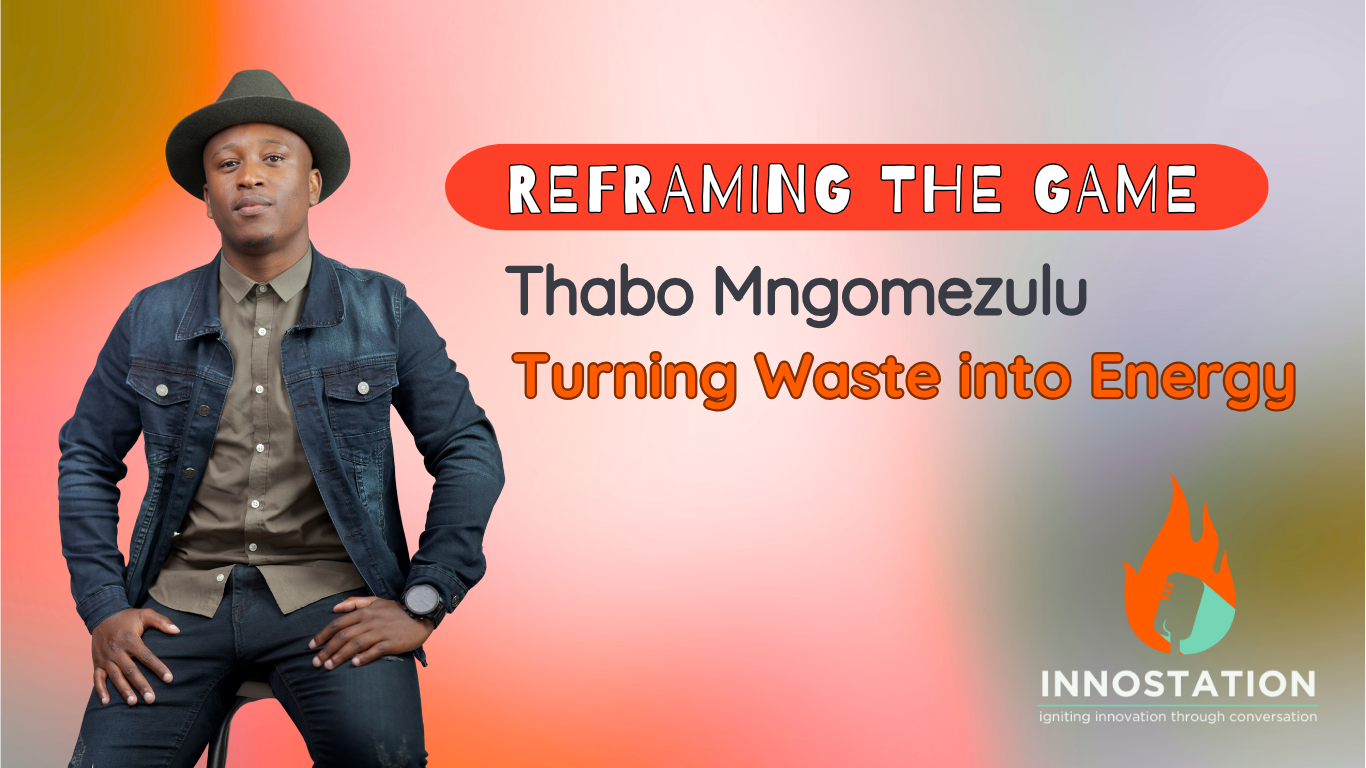
“I needed an alternative to be able to survive in Joburg, but secondly, because people were really going through a lot during COVID, it made me want to make a difference while I make money.” – Thabo Mngomezulu
When lockdown silenced South Africa’s music scene, Thabo Mngomezulu didn’t stop creating, he simply changed his medium. A jazz musician by training and a performer by passion, Thabo found himself searching for a way to bring both purpose and stability into a world that had suddenly gone quiet. What began as a small crop-farming project soon became something far bigger: an idea that could light up homes and redefine what energy innovation looks like in rural South Africa.
Born and raised in the small village of Fernie, Mpumalanga, Thabo understood firsthand what limited access to reliable power meant for communities. After losing his income as a performer during lockdown, he turned to agriculture and, through research and curiosity, discovered the untapped potential of biogas. “I realised that the most urgent need at the time was energy,” he said. That realisation became Kasi Gas! A company turning organic waste into clean, renewable energy and fertiliser for rural households.
What makes Kasi Gas remarkable is how local it is. Thabo launched his first plant in Fernie, the same community he grew up in, and began showing residents how everyday organic waste could power their homes. He invited them to see the process firsthand, demystifying the science and rebuilding trust in an unfamiliar concept. People who once doubted that “waste could burn” are now cooking meals using energy drawn from it.
Still, Thabo’s journey shows that innovation alone isn’t enough. As South Africa transitions toward cleaner energy, many brilliant ideas remain stuck at the concept stage, not because they lack potential, but because they lack funding and support. “The challenge we always have is money,” Thabo said. “It’s not that we don’t know what to do.” He dreams of a national crowdfunding system where every South African could contribute even one rand toward home-grown innovations, a way to power new ideas collectively, not just financially.
Beyond money, Thabo believes compliance and education are critical barriers. Too many small businesses fail to access grants or partnerships because they aren’t registered or don’t know how to report formally. His advice to young innovators is simple but powerful: “It doesn’t matter how small your business is. If you comply, you might be able to attract the right funding.” For him, the real magic isn’t in the machinery, it’s in seeing rural entrepreneurs take ownership of solutions that can change their own communities.
Thabo’s story is a reminder that innovation doesn’t only happen in laboratories or boardrooms. Sometimes, it’s born in a village at the edge of Mpumalanga, from a musician who refused to stop creating and decided to turn waste into light instead.
Listen to the full episode of InnoStation to hear how Thabo Mngomezulu and Kasi Gas are proving that South Africa’s next big energy revolution could start right in our own backyards.
Listen to the episode
Links
Website: Kasi Gas
Transcript
Kami 00:00:06 – 00:00:47
You’ve just tuned into Innostation, where the latest and hottest topics are always on air. I’m your host, Kami, and each episode we serve up heat with fun chats, fire insights, and special guest appearances with a few surprises along the way. Now, the South African energy crisis is one of the country’s most persistent challenges. While many are turning to alternative energy solutions, high costs are still leaving countless rural communities in the dark. Today we’re joined by Thabo Mngomezulu, who is the founder of Kasi Gas, which is an innovative company turning organic waste into biogas and fertiliser, bringing cleaner, greener energy solutions to South African communities. Welcome to InnoStation Thabo.
Thabo Mngomezulu 00:00:47 – 00:00:49
Thank you for having me. Hi, Kami.
Kami 00:00:49 – 00:01:12
Of course, of course. I’m so excited to have you. I’m so excited for this conversation. You’ve had quite the journey, coming from a rural agricultural background, to then having a career in music for the better part of a decade, to moving into the energy space. Will you tell us a bit about yourself and the journey that led to the foundation of Kasi gas?
Thabo Mngomezulu 00:01:12 – 00:02:44
Right. It’s a long story, but I’ll try and cut it short. So basically, Thabo grew up in Fernie. It’s a small village in the heart of Mpumalanga. A lot of people don’t know it because it borders Swaziland and it’s right at the end. So I decided to move to Johannesburg when I was 20 to pursue my love and passion for music. And I went to music school and I studied music, jazz, to be specific, and I graduated from that. And then I started singing professionally in the industry, both in jazz and gospel and Afro pop. So during the harsh restrictions of lockdown, unfortunately a lot of us lost our income, so we couldn’t geek anymore because gatherings were restricted. So I kind of needed an alternative to be able to survive one in Joburg, but secondly, because people were really going through a lot during COVID especially at home. You know, you’d find that a family does not have food. This and that is happening, or these people bought food and then it’s rotten in the fridge, you know, things like that. And so it kind of made me want to make a difference while I make money. And so I started a crop farming project with a few of my friends in Joburg. I realised that that isn’t enough because we produce a lot of waste and as much as we can produce food. It was small scale. I think the most urgent need at the time was energy.
Kami 00:02:44 – 00:02:45
Yeah.
Thabo Mngomezulu 00:02:45 – 00:03:51
Then I started doing my research into organic waste. And then luckily I came across biogas. And yeah, I then started my research and then I pursued the journey and I did that for three years. I wasn’t a business person anyway, so, yeah, to do things like cohorts and accelerators through foundations that were really good at teaching us the basics of business, understanding how to pitch, writing a pitch deck, writing a business proposal, those kinds of things. And also the jargon of, you know, business. Because a lot of people would come there and just drop words and you’re thinking, what the hell does that mean? I spent a lot of my time learning that and then eventually in 2024 I pitched and then I got funding and obviously I’m biased because I grew up in Fernie. So when I got the funding, I wanted to start here in Fernie because I mean, I understand it and I’ve got relations with the local leaders and things like that. And so yeah, I left my work and I left music to pursue biogas production and it’s been fulfilling turning waste into energy and seeing how people interact with that.
Kami 00:03:51 – 00:04:11
Yeah, and I think that that is the most interesting thing to me is like you hardly ever have like creatives moving out of the creative space into spaces like energy. So I imagine that must have been a very daunting transition because you genuinely don’t know what you’re getting into. It’s two completely different worlds. But you are here and you’re doing great. So shout out to you.
Thabo Mngomezulu 00:04:11 – 00:04:13
Thank you, thank you.
Kami 00:04:13 – 00:04:34
And on the topic of alternative energy sources, when we speak about that, we always primarily hear about solar and wind, but we don’t always hear about organic waste. Why do you think that South Africa hasn’t fully tapped into the organic waste solution as an alternative energy source for the country?
Thabo Mngomezulu 00:04:34 – 00:05:08
So I read an article that South Africa did actually try to do a Biogas initiative like a long time ago. But the challenge then was that electricity was very cheap in South Africa. It was to nothing because a lot of our coal actually went into electricity production. So there wasn’t a need for biogas. And I guess the idea was just dumped then as to this is a failed project, it doesn’t work and things like that. But now things have changed. Electricity is quite exorbitant. So a lot of people are looking for alternatives.
Thabo Mngomezulu 00:05:08 – 00:06:15
And during COVID solar was also very costly and still is for a lot of the population, and so people don’t actually explore different kinds of energy. I think we just all rely on Eskom and we’re like, oh well, if we don’t have Eskom then we can install solar and things like that. But people don’t actually think beyond that because there isn’t a lot of education that goes in with regards to different kinds of energies or energy sources in South Africa. And so organic waste has been looked down upon, but right now the population is growing and there’s a lot of waste produced and starting to become a problem. And our world also transitions from fossil fuels to renewable energy. There is a bit of interest, but it’s still very low in South Africa. And I think it has to do with our education system. Also the fact that people aren’t really interested in energy and knowing how it gets to their houses. If you ask a normal person, they don’t know what causes load shedding. But we’ve had it for the past, I don’t know how many years, 13 years, 14 years.
Kami 00:06:15 – 00:06:16
Yeah.
Thabo Mngomezulu 00:06:16 – 00:06:22
People are disinterested. They just want to pay and get the services.
Kami 00:06:22 – 00:06:46
And I think off the back of that, I mean, I imagine things like that do make starting a business in the energy space very challenging. Right. Because there also isn’t like the buy in from people in terms of like, they know what it is that you’re doing, they understand the marketing so they can show up for you. So can you tell us some of your biggest challenges that you’ve experienced with not only starting a new business but also starting a business that hinges on such an innovative idea?
Thabo Mngomezulu 00:06:46 – 00:07:16
Well, the challenge I had, which is very interesting, is that… so when we started the bargain initiative, we thought we were going to sell it in 1 cubic meter bags which is going to cost 20 rand and people are able to cook for two to three days. And I thought, wow, that’s a bargain. You know, people would want that. But when we did our surveys and we started demonstrations and people looked at this because they were like, nah, this is not safe. And you can’t really convince them that the bag is safe because it works the same as a gas cylinder.
Kami 00:07:16 – 00:07:16
Yeah.
Thabo Mngomezulu 00:07:16 – 00:08:49
And another challenge that we found was that people don’t trust biogas because it comes from waste. And so they were always thinking, well, it smells, I’m sure it must smell, you know, and things like that. But you keep on explaining, no, through the process of producing biogas, you then scrub it and you take out the sulfur. Sulfur is the gas else, you know, trying to do that. So it’s been quite a challenge trying to explain to them that there’s a flame that can actually come from organic waste. But luckily for me, I was able to then prototype, and then invite people to the plant and then demonstrate to them and show them exactly what is happening. Then that’s when they thought, I’m a magician or something. But a lot of people who actually studied chemistry and physics in school actually remember this process, they know that methane burns. I’m not sure if you’ve seen when the cow is bloated and then they pierce the cow and then there’s methane that comes out and there will be a demonstration to show people that it burns. So LP gas is propane, butane and then biogas is basically methane. So it’s the same kind of person gases, they have a flame, you know. So yeah, it was kind of difficult to get people to understand that you can actually generate electricity or energy to cook and heat through organic waste. But obviously overcome that by doing, you know, allowing people to your sites so that they understand what actually is going on.
Kami 00:08:49 – 00:09:29
And I think that’s the thing, isn’t it, is it always helps to bring people behind the scenes, they can actually see that it works and stuff. Because a lot of the time when you’re putting something new in the market that people don’t have experience with, there is that sort of hesitance at first to even try to engage with what you’re doing. And I think as South Africa, we are not a nation that has a shortage of innovation and ideas. And there’s a lot of drive, I think, to sort of get things started and your journey and your business is an example of that through your experience. What are some of the things that you think that we can do as a country to sort of support innovators and help them make their ideas into reality.
Thabo Mngomezulu 00:09:29 – 00:10:04
I’m not gonna beat about the bush. The challenge we always have is money. It’s not that we don’t know what to do. The problem is always the financial constraint to it. I wish there was a country’s crowdfunding thing where everyone could just put one rand and things like that and they would support innovators and innovation because we’re basically disrupting what the government is doing, what other markets are doing, you know, things like that. So there’s no way you’re gonna get support from the get go. Obviously what everyone wants to see, the traction, what people want to see, if it picks up and you know, things like that.
Kami 00:10:04 – 00:10:06
Yeah.
Thabo Mngomezulu 00:10:06 – 00:10:52
A crowdfunding system as a country where that money just goes to innovators. But obviously we know the challenge we have in our communities. We can’t work together. But that is my one wish because there’s a lot of innovations out there that are dying. Organisations such as the CSIR who have been innovating for years and years and years and they’ve never actually commercialised because of the lack of funds and things like that, which is really sad. I mean, we used to be leading in so many industries. I mean, I think the first transplant happened here in South Africa. When you look at the nuclear power, Africa was leading. There’s so many things and innovations that were happening here but with time they’ve died down because of the financial constraints.
Kami 00:10:52 – 00:11:25
And I think that’s a bit weird, isn’t it? Because we have so much need for innovation now more than ever and yet there still is a lack of funding going into projects like in the energy space, in the water space even. And it’s kind of strange because we have a need for this stuff. It’s not like asking for funding for things that are more so ones like lifestyle based. It’s like genuinely trying to solve problems that affect the entire nation. And so I think that’s a great idea. Like a little crowdfunding thing where innovation cyclists can’t get funding.
Thabo Mngomezulu 00:11:25 – 00:11:27
Yeah. That would really, really help.
Kami 00:11:27 – 00:11:39
Yeah. What advice do you have for South African youth looking to start their own business or initiative, especially people that are based in rural communities.
Thabo Mngomezulu 00:11:39 – 00:13:42
Yeah. For me the biggest thing was that I had a government fund. It’s actually the Technology Innovation Agency which is a wing of the Department of Science, Technology and Innovation. And one thing they always scream is compliance, compliance, compliance. People uncompliant. And even when they’ve gotten the money or the grant, when it comes to the reporting part, it’s always a problem, so innovations are not lacking. Business ideas are not lacking. The challenge is the compliance part. Are we doing enough to teach ourselves how to comply? We know what CSD registration we do. We are registered with the CIPC, with SARS and things like that. So that’s the advice I would kind of like to give. It doesn’t matter how small you think your business is, but if you comply then you might be able to attract the right funding. Because you see a lot of businesses in rural communities and they’re really, really good, but they’re not registered. And so if someone wanted to fund something like that, there’s no proof of activity or sales, there’s no business account, you know, and things like that. So the advice is look into compliance, try and learn. And it is complicated, but if you can get that right, then I think these other things can follow. And also there are funds in South Africa that are not being utilised because like I said, the challenge is always compliance. And also people don’t know how to write proposals, they don’t know how to communicate their business effectively. So there are things called accelerators and cohorts and fellowships where they teach young people how to write proposals and things like that. So, you must also look into it. There’s no need to go to university to study an entrepreneur degree or diploma and things like that because this accelerator would basically teach you the same things. And it’s always great to be hands on and to be on the ground because that’s where you learn the most. So whatever business it is, even if you’re selling sweets, whatever it is, look into how can I make this as professional as possible?
Kami 00:13:42 – 00:14:29
Yeah, and I like what you’ve said about sort of regardless of the size of your business because I think with a lot of small business owners that I’ve spoken to personally. The things like compliance and all of that aren’t necessarily always top of mind or like the key concern. I think people get caught up in the hustle and bustle of it all and you sort of neglect to realise that like, okay, what if this thing actually grows past like what I expected? Then you run into compliance issues, etc, and that can slow down the growth of your business. So I think that is a good thing to note. And also what you said about sort of learning, like throwing yourself into the learning process and it will be challenging, but I think you are a great example of, like I said, being creative and getting into the energy space. Imagine the learning journey must have been very strenuous. But it’s doable.
Thabo Mngomezulu 00:14:29 – 00:14:59
Yeah, it’s true. Every day I was learning a new word and a new term. It was so funny. Even the basic things, like someone would say a unique value proposition. And I was thinking, what the hell is that? For me it was quite a long journey because when someone said a word, I needed to go back to Google and sort of like research it and see what’s happening and then read a whole article just to understand one word. But then I did it anyway.
Kami 00:14:59 – 00:15:20
Yeah, and I think it’s, it’s, it’s so relatable Right. Because for us at an agency level, you interact with so many different clients and some of our clients exist in very technical industries. And there is every day a term, a thing that is said that you don’t know what it means. But thank goodness for Google, right? Because you can always just pull out your phone quickly and find out.
Thabo Mngomezulu 00:15:20 – 00:15:23
Thank you.
Kami 00:15:23 – 00:15:39
Thank goodness for ChatGPT. Before I let you go, I’d like to play a round of hot takes with you. How it works is that I’m going to give you three categories. You’re going to choose one category and from that category you’re going to answer a mystery question.
Thabo Mngomezulu 00:15:39 – 00:15:40
Okay, cool.
Kami 00:15:40 – 00:15:47
So your categories for today are education, marketing and entertainment.
Thabo Mngomezulu 00:15:47 – 00:15:53
Education, Education, education.
Kami 00:15:53 – 00:16:41
But I think you’ve touched on this one already. Right? Because the question is if traditional degrees were to disappear today, how would you prove your skills to land your dream role? So how would you go about learning to land your dream role if traditional degrees were gone?
Thabo Mngomezulu 00:16:11 – 00:17:18
So I know a guy from India, so his friend actually started this village where the module is just water. So they don’t go to normal schools. They go to teach themselves about water, energy. I forgot. And food. I think that’s me. And that’s something basic that everyone knows that they will need, and so you can just learn from doing. You can learn from others who are actually in space. I think that’s how I would take it because we were taught to go get our degrees, but now we’re stuck with our degrees because what the hell are we doing? You know, South Africa requires that you invest into infrastructure and basic things like energy and food. You know, those are things that people are always going to be needing. And so those basic things, I think I’ll get into that space in that manner by being hands on. If I wanted to learn about food, I’d start planting today and see what works and see what doesn’t, you know. So I think, yeah, that’s how.
Kami 00:17:18 – 00:17:44
Yeah, just sort of getting into the practicality of it and actually doing it. Yeah. And I think that is the way that a lot of the job market that I’ve seen is moving in that direction. People are sort of being more focused on skills versus sort of just having theory based knowledge. Right. Because then it’s more important for you to be able to do the thing than know just the basics of how to do it. So that makes sense. Yeah.
Kami 00:17:44 – 00:18:43
Thank you so much for joining us today. I think this was such an interesting conversation and hopefully it inspires somebody to also just start looking in different directions to sort of start their own business especially in spaces that might feel a little bit intimidating like energy. We can look to you and see that it is possible and it really is doable even with no background in that space and the audience. Thank you so much to everybody who tuned in today. Don’t forget to hit that subscribe button and turn on your notifications so that you don’t miss our next drop and then we would also love to hear from you. So let us know what your take is on sort of the use of alternative energy sources, being biogas, being anything else that you’ve seen that you feel like is an interesting sort of energy source that we could be implementing in South Africa to sort of get ahead of the energy crisis. And we will catch you in the next episode. Bye bye.