
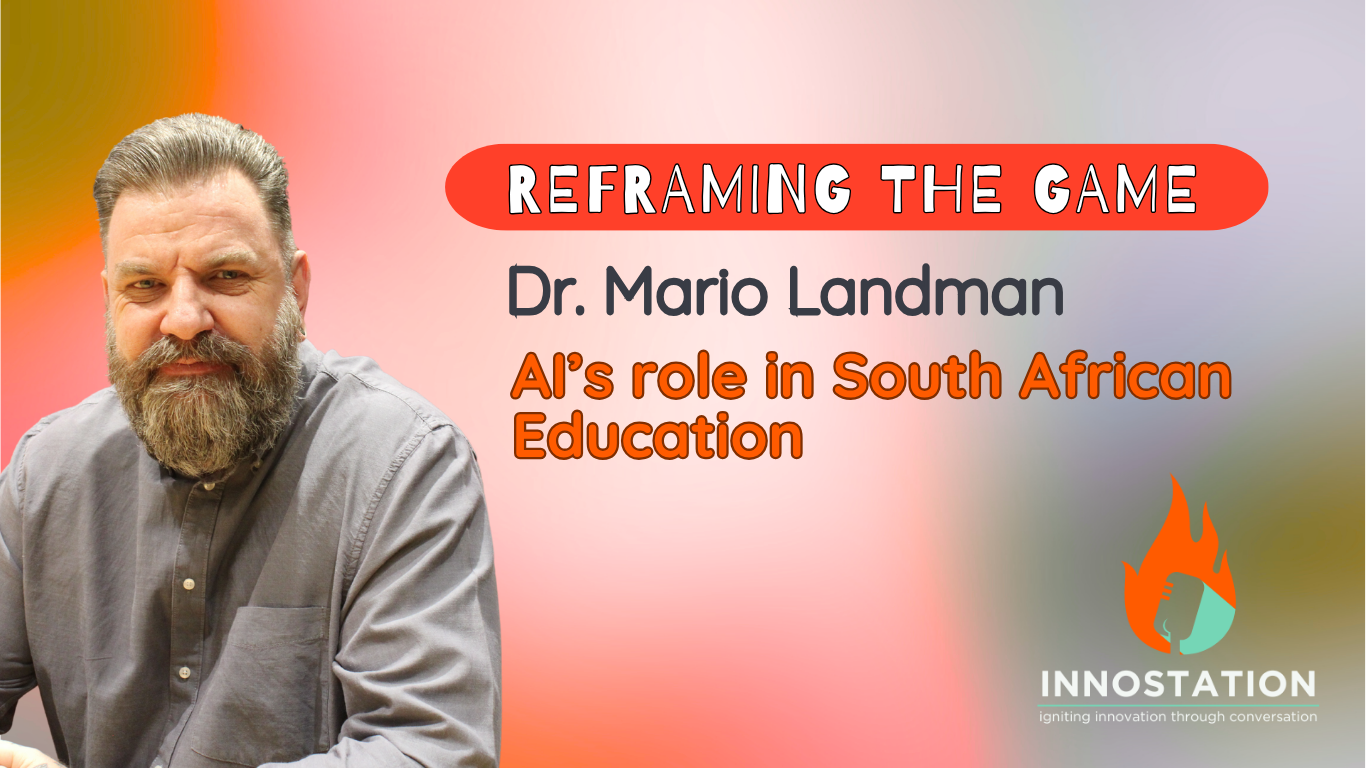
While many institutions are pushing back against AI, the Independent Institute of Education (IIE) is taking a very different route. The IIE is embracing AI as a catalyst for transformation rather than a threat to tradition. For Dr Mario Landman, Head of Educational Technology and Innovation at the IIE, the goal isn’t to replace educators but to elevate how learning happens. “AI, like the calculator, should elevate thinking, not replace it,” he says. “It should push us towards higher-order learning.”
That mindset has guided the IIE’s journey into adaptive learning, an approach that allows learning content to evolve with each student’s needs. But before AI entered the picture, the IIE had already set a strategic direction that required reimagining the entire learning ecosystem. When Dr Landman joined the institution in 2023, his first task was to find a new learning management system that could carry that vision. “We had to move away from static, stagnant platforms that don’t engage students,” he explains. “We wanted something dynamic, responsive, a foundation for whatever the future might bring.”
Brightspace
After a long RFP process, the IIE chose Brightspace by D2L, not just for its technical capabilities but for its adaptability. Dr Landman jokes that selecting the right LMS is less like buying a car and more like “shopping for a spouse.” It’s a long-term relationship, one built on trust, growth, and shared values.
The shift to Brightspace paved the way for the IIE’s AI integration, which came soon after ChatGPT’s rise in late 2022. While many institutions reacted with fear, banning AI tools or tightening plagiarism policies, the IIE did something rare: it paused to reflect and craft a shared philosophy. “Before we wrote policies or launched tools, we created an AI manifesto,” Dr Landman says. “It outlined our ethical stance, our goals, and our commitment to academic integrity.”
AI manifesto
That manifesto defined AI as a teaching and learning enhancer, not a shortcut. It recognised AI as a new digital literacy, a skill as essential as reading or coding, that both students and educators must learn to navigate responsibly. From there, the IIE moved to policy: ensuring that every AI tool introduced would be available to everyone across its network, avoiding the digital inequality that plagues so much of South Africa’s education landscape. “Whatever we roll out has to be available to everybody,” Dr Landman emphasises. “Equal access to opportunity is the only ethical way forward.”
The institution’s future ambitions include integrating AI literacy from early childhood development through to tertiary education. The goal is a generation fluent not only in using AI but in thinking with it creative, critical, and ethically grounded. “It’s almost scary to see what young learners could achieve if we get this right,” Dr Landman reflects. “Imagine what a child who’s fluent in AI could do by the time they graduate.”
For the IIE, this journey isn’t about chasing technology for its own sake. It’s about redefining what education means in an age where machines can learn alongside us. It’s about shaping a future where AI isn’t feared, but understood and used to push human potential higher than ever before.
Listen to the episode
Links
Website: Independent Institute of Education
Transcript
Kami 00:00:10 – 00:01:00
You have just tuned into InnoStation, where the latest and hottest topics are always on air. I’m your host, Kami, and each episode we serve up heat with fun chats, fire insights and special guest appearances with a few surprises along the way. Now, AI isn’t just AI a buzzword anymore. It’s reshaping how entire industries think, work and evolve. And with every new development, it sparks fresh excitement. But it also raises big questions around the future of work, learning and innovation. Today we’re zooming in on AI’s role in higher education, which is a space where change can be both challenging and transformational. The IIE in particular has taken a bold forward thinking stance on AI integration, leading the way with innovative approaches that set the tone for what education could actually look like in the next few years.
Kami 00:01:00 – 00:01:20
And joining us today to unpack this journey is Dr. Mario Landman, who is the head of Educational Technology and Innovation at the IIE. He’ll be walking us through how the institution has embraced AI through the BrightSpace platform and what this means for students, educators, and the future of learning. Welcome to InnoStation, Dr. Mario.
Dr Mario Landman 00:01:20 – 00:01:24
Good morning, Kami, to you and your listeners. Thank you for having me.
Kami 00:01:24 – 00:01:40
Of course. We’re so excited to have you here today. And before we get into sort of your academic career and your role at the IIE, we’d first like to start by getting to know you a little bit. So tell us who Dr. Mario is and what fuels your inner fire.
Dr Mario Landman 00:01:40 – 00:03:10
Oh, gosh, that is a big question. And to answer that question, I need to go right back to the beginning. So I didn’t start in education. I started in the film industry, funny enough. Yes, as a film editor. And one day I got a call. I was very passionate about the film industry, but it’s incredibly hard work and it was difficult to find consistent work. I mean, one day I replied to an ad. I think it was the East Coast College was working in Cape Town at the time and they needed someone to tutor film students in film editing. And that is sort of how I got involved in education. And I just found it enormously rewarding. So while I loved the film industry, I found it even more rewarding to see how the work that we do impacts on these students, how they’re learning these skills, and how they can apply it in their workout. Just sort of sets them off into a particular trajectory and just to see how they grow and develop, it was just enormously rewarding. So I nearly quit my job in the form industry right there. But I did take it slow. I decided to study a bit further and then eventually with a plan of eventually ending up in education full. So what fuels me is students, their passion, their excitement. What education can potentially do for their lives, how life changing it is to not only them, but their families and their communities. So the impact of education is what fuels my fire.
Kami 00:03:10 – 00:03:39
And I like that. I think that’s a very important sort of outlook to have, especially if you work in the edgy space, is actually being passionate about not just the content, but the people that you’re actually serving in that particular industry. And we know that earlier this year the IIE sort of started using AI platforms across the institutions. Can you walk us a little bit through the process of what made you choose brightspace in particular over other similar applications for that move?
Dr Mario Landman 00:03:39 – 00:05:56
Sure. So I joined the IIE in September of 2023, so just a little over two years now. And it was. My initial function was to find a replacement LMS for the one that we’ve had. We had a particular LMS in place for 15 years. And while it was great and it served us particularly from a standardisation perspective, we’ve got a huge institution. It ticked all of those boxes. But we had to take a new strategic direction. And that strategic direction broadly fell under the banner of adaptive learning. So adaptive learning effectively means that what we put in front of students changes. Now, there’s a lot of detail around that, but that is effectively what it came down to, is that we can’t have stagnant platforms, we can’t have platforms that are not engaging, that are not reactive. So we had to find the next LMS. And the LMS is the core to any institution’s ethics strategy. Everything latches onto it, everything plugs into it. But the LMS as we call it in our space is for plates. You serve food on the plate, but you need a plate to serve that food first. So we had an enormously robust RFP process. We had hundreds of functional requirements that we were testing. We were looking for a particular LMS that would serve us in the long term, but something that was very agile in its roadmap, something that was, you know, just very robust in its development. One of the… While we were going through the RFP process, we were interviewing a lot of institutions, CIOs and Etech strategists from a lot of institutions around why they were selecting other particular LMSs. And a comment that came through was that when selecting an LMS, it’s not just important to focus on the functionalities. Because you’re not buying a car, you are effectively shopping for a spouse. So you’re looking for a long term commitment.
Dr Mario Landman 00:05:56 – 00:07:52
It’s like shopping for a wife is what this person said. So that sort of stuck. So we were looking for someone that we could form a partnership with, someone that would listen to our evolving needs and our strategies and that voice would have a direct impact on the roadmap. So we ended up with D2L. They ticked all of the boxes from a functional requirement, but from a sort of partnership requirement, this sort of overarching relationship that we were looking for, they ticked that box very thoroughly. So it wasn’t specifically around AI or adaptive learning. It was around having a platform that would allow us to grow regardless of what that strategy is. AI as a strategy came a little later. But because of this platform that we’ve decided on that is so agile in its developmental pathway, we were able to very quickly add AI features to it. And we are continuing to add AI features even as we speak. And within the next couple of years we’re adding more. The platform allowed us to effectively realise our AI strategy as it evolved. So we didn’t have all of our cards, all of our ducks in a row to begin with. We had a sort of a rough idea. We want to get to this goal of adaptive learning. Eventually, AI is a potential way of getting to that goal. But there are many steps, technologies, tools, things that we would need to resolve before we can get there. And B2L just threw their developmental roadmap, the almost aggressive acquisition of third party providers. So instead of us shopping for solutions, they have solutions within their family of products that we could pull in. All of that was enormously helpful and.
Kami 00:07:52 – 00:08:38
I think it’s very interesting, sort of just tapping into the IIE’s AI strategy. That AI came after the fact. So you generally were just looking for a platform that would allow you to then be able to integrate whatever the future might bring. And I find that with the conversation around AI in the education space especially, it tends to be very divided and sometimes it’s a little bit skewed against AI. And that might be because of concerns like academic integrity. Right. Like a big conversation is people using AI to cheat. There’s plagiarism, there’s a whole host of things that you have to consider. So why did the AI choose to sort of integrate AI instead of trying to prevent it in your strategies?
Dr Mario Landman 00:08:38 – 00:10:47
Yeah, so if you look at what was happening in the world after November 2022, so November 22 ChatGPT rolled out almost immediately. You could see that in the research within the academic forums, within the whole scholarly world, there were these two teams forming. A very polarised view on AI was forming. You had those that directly opposed it, that was looking at AI and the word devil was, I can’t remember when it was used in an academic conversation. But very prominent academics like Noam Chomsky were referring to AI as the devil. So you had all of the sort of guys that sort of followed Chomsky, and then you had your large traditional universities, and then everybody else was sort of on the other side of the line. But over the last couple of years, these two polls sort of found each other somewhere in the middle. And I think even the parties that refer to AI as the devil initially understood that it is not something that we can get away from. So we need to look at how we can incorporate it into teaching learning in an ethical manner. So very early on, the IIE sort of associated themselves with that group. So the group that looked at AI from a developmental perspective, we recognised the problems, we recognised the potential for infringement on academic integrity and the work that we would need to do to safeguard our academic integrity. So all of that we were pretty clear on. And our first step was to cement that view in a manifesto. So before we got into policy, before we got into guidelines, before we tried to incorporate AI technologies, we sat down as an institution and started what is, what does AI mean to us? And that we put into a simple seven point manifesto. And I’m not going to read through all of it, but effectively we position AI as a tool for enhancing the teaching and learning process. We commit to ethical use, we commit to academic integrity.
Dr Mario Landman 00:10:47 – 00:12:01
We also commit to the development of AI as a new literacy. And a lot of institutions didn’t immediately realise that we are dealing with a new digital literacy. So are we ensuring that we teach this language of AI not only to our students, but also to our faculty? How do we incorporate it formally into the teaching learning process? And we emphasise the positive effects of AI. So one of the analogies or the comparisons that is often drawn is the introduction of a calculator. And in a discussion recently, I showed pictures of how people were toying in Madison Square Garden when the calculator came out. All these math teachers in the, I think it was the early 1980s and they were putting down tools and it was just not on. And we were fighting this thing called the calculator. But what the calculator did was it elevated mathematics As a scholarly practice, a couple of levels beyond where it was, because the sort of dog work, the rote work, those lower level stuff in the Bloom’s taxonomy, the calculator could take, could, could replace, and that therefore pushed the curriculum upwards. The exact same thing is happening with AI. So we are very strongly punting AI as a catalyst for higher order thinking. So asking lecturers, those who develop assessments, curriculum, courseware, et cetera, to critically look at what they’re putting in front of students and realising. But this layer here that we were emphasising for so long and we were grading and put weight behind it and energy behind it, AI can now replace that so that we can focus on that next level and next level and next level of thinking in relation to a specific discipline. So all in all, it elevates society. If we do so in a controlled way, if we do so in a managed way, and we’ve got the safeguards in place and the policies in place, and we train our people, that is the route that we decided to go, we decided to embrace it, but in a very controlled manner to ensure that the real benefits of AI realises itself within our business.
Kami 00:13:04 – 00:13:39
Yeah, and I like the approach of sort of recognising that AI now gives a new layer to sort of digital literacy as well, because, and I think this is a larger conversation in the South African landscape of like the big digital divide that we still have and are still navigating. Right. And I mean, even people who do have access to technology are not necessarily digitally literate or fluent. Do you think that the integration of AI into the edgy space, especially in higher learning, might exacerbate the existing digital divide that we have? Or do you think that it could actually help us sort of bridge it a bit?
Dr Mario Landman 00:13:39 – 00:15:27
So the discussion that you’re referring to is around the democratisation of AI, and it’s a difficult one in South African society because those of us that have access to these premium AI products have an advantage over those that. So again, it’s, it creates or it re-emphasises that social divide between the haves and the have nots. So absolutely that potential is there. But as an institution, we decided that whatever we roll out in regards to AI, every platform, every tool has to be available to everybody. So not to use specific brands within our group, not to specific students or faculties, not to specific disciplines, but everybody. So that everybody has that equal opportunity to reap the benefits of AI. But yes, outside of the academic context, it is a concern and we already see that there’s a whole gig economy that is driven by AI. I mean, we are completely flooded by all of these adverts on how, you know, teenagers are building these enormous industries of AI in the out of their bedrooms. That unfortunately is something that we have little control over. What we have control over is the ethical use of AI within an academic context and ensuring that everybody gets the same leg up, everybody gets the same opportunity, everybody gets the same benefit within our space. So I’m hoping that other institutions would do that as well and that the rollout of AI should rather be paused than staggered until institutions are ready to give that benefit to each and every one of SD students.
Kami 00:15:27 – 00:15:49
And just in consideration, like other institutions sort of adopting the same sort of thinking around AI and tech, do you think that we should be, I mean, right now we’re discussing sort of the role of AI in tertiary education. Right. But do you think that we should be bringing this in a little bit earlier in the game, like maybe at a high school level, maybe primary school level as well?
Dr Mario Landman 00:15:49 – 00:17:55
Absolutely. Within our institution we’re already having conversations of how this AI literacy would manifest itself from early childhood development all the way through to the highest level. So it’s early days, but the awareness is there, we now have policy in place to make that a reality. So after our manifesto, we developed a policy for the integration of AI in teaching and learning. And that would now allow us to, or give a permission to those that do curriculum development, that do lesson planning, that do courseware development, assessment development, to start including AI within those academic artifacts. But certainly the planning is there, it is a slow process because even though we have a manifesto, we’ve got a particular view, we’ve got policy, we’ve got an enormous business, thousands of lectures, thousands of teachers. So it’s going to take us a bit of time to get that, that momentum going, but we are already starting it. And that is definitely the consensus across our schools and our tertiary brands that there should be a formal integration of AI at every level, starting with early childhood development. So I was very pleased to see that. I was shown some, some plans for an initial curriculum. And it’s almost scary to see what we, if we do this correctly, how very young children would be able to develop higher order proficiencies in AI very early. Can you imagine what that child would be able to do by the time they leave varsity, by the time they interview the work market? So it’s a purposeful but well structured and calculated introduction of AI across our business and yeah, we’re very, very excited about it.
Kami 00:17:55 – 00:18:54
And I think that is so exciting because a lot of the conversations that I had around AI are sort of in how they’re changing industries. Right. But I mean, to get into industry, you have to go through the full education system. And if you’re only then learning about it in uni, it kind of defeats the point of, like, because you go into the markets and then you might bump into people that have been sort of integrating this into their learnings from, like, way back in the game, and then it just creates issues. But I think that’s also one of, like, my favorite things about the IIE in particular is everything is sort of very future thinking. It’s very intentional in terms of like, we’re prepping you. I mean, when I was at the IAE’s Varsity College, a lecturer of mine would always say, like, we’re not just like, the industry is still how it is, but I need you to be able to be in the industry 10 years from now and not necessarily be playing catch up, but already know what’s happening. And so I think having sort of that kind of thinking gives you a leg up. So shout out to you guys for considering all of these things.
Dr Mario Landman 00:18:54 – 00:18:57
Well, we try, we try, we try.
Kami 00:18:57 – 00:18:59
All you can do is try, right?
Dr Mario Landman 00:18:59 – 00:19:02
Yeah.
Kami 00:19:02 – 00:19:16
Dr. Mario, before I let you go, I’d like to play a round of hot takes with you. And how this works is I’m going to give you three different categories and you’re going to choose one of them, and then from that one category, you’re going to answer a mystery question.
Dr Mario Landman 00:19:16 – 00:19:18
Okay, cool.
Kami 00:19:18 – 00:19:26
So your categories for today are education, technology and society.
Dr Mario Landman 00:19:26 – 00:19:29
Let’s try technology.
Kami 00:19:29 – 00:19:43
Technology. Okay, your question is, if you had an AI robot to take over one of your daily tasks, no matter what the task is, no matter what area of life it’s in, which one would you happily hand over right now?
Dr Mario Landman 00:19:43 – 00:20:29
Email writing. Email writing. And yeah, I mean, I don’t want to. I don’t want to upset my employers, but I use AI quite a bit for email writing already. But if there is something that I wish I could automate and there are already these signals available, it’s just not something that I’m confident in using. It would be to get, you know, help get through emails quicker. So, yeah, I’m already using quite a bit of AI to help me manage email. But if I could cut that particular part of my day out completely and it allows me to focus on the important work, I would happily hand that over to a robot most definitely.
Kami 00:20:29 – 00:20:47
And I saw a meme about that the other day where somebody was saying I used to be able to write like a 300 word essay in an hour in the exam room by myself and now I can’t even write a simple email. I’m like, can you make sure this sounds professional to ChatGPT?
Dr Mario Landman 00:20:47 – 00:21:18
Absolutely. And yeah, I mean, that’s a different discussion. I heard a name for it the other day. It’s called cognitive developmental debt. So by getting the AI to write that smart email now, you’re robbing yourself of the opportunity to develop into a person that can write those smart emails. So I need to be very careful of that. But I’m willing to take that risk. I don’t need to be able to write smart emails. I just need to be productive. And I don’t always feel that emails are a productive part of my day.
Kami 00:21:18
I totally get you. It takes so much out of your day, actually. But Dr. Mario, thank you once again for joining us today. And thanks to everybody that tuned in today as well. Please don’t forget to hit that subscribe button and turn on your notifications so that you don’t miss our next job. And we would of course also like to hear your thoughts. So in the comment section, let us know what you think about the integration of AI in higher learning and I will catch you in the next episode.