
South Africa’s energy sector is at a turning point and this time, the countdown to compliance is real. With Energy Performance Certificates (EPCs) now mandatory for building owners, businesses are racing to meet the December deadline or risk steep fines and reputational damage.
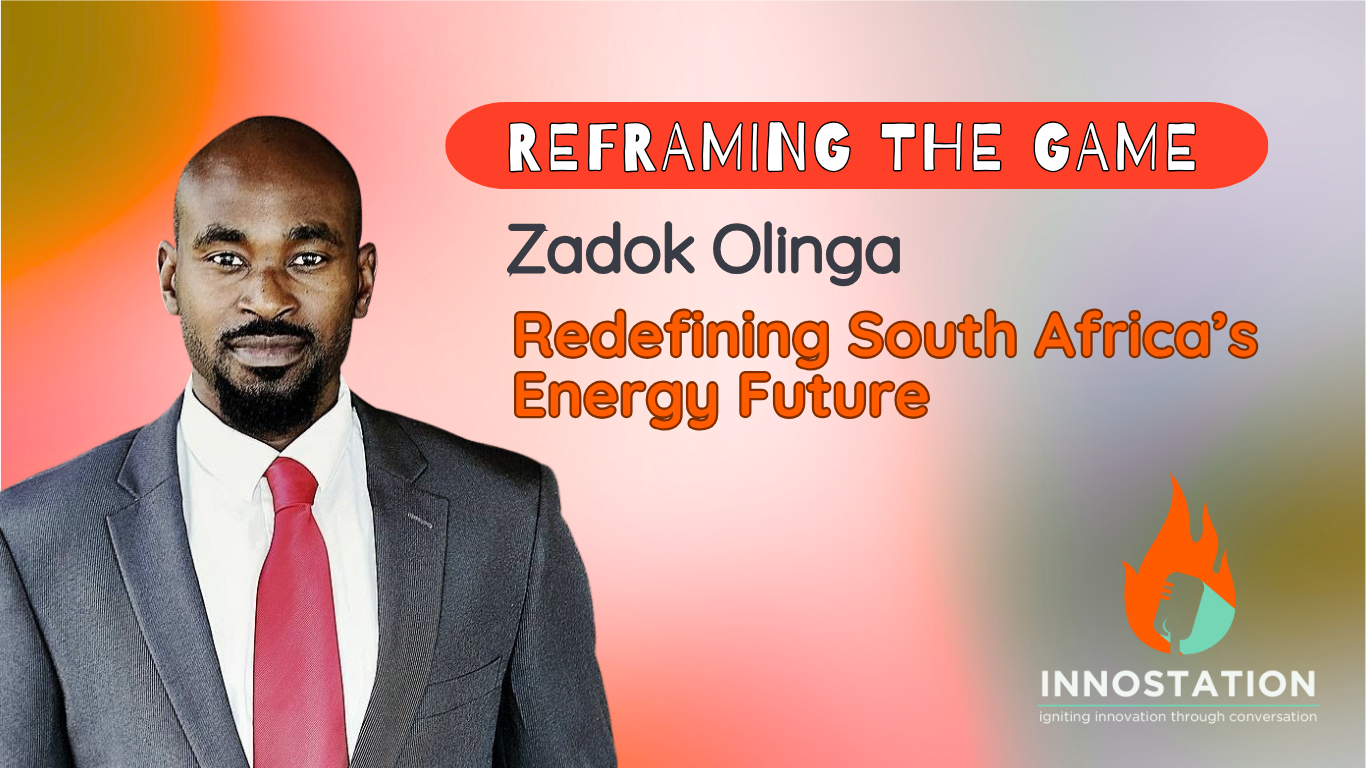
In this episode of InnoStation, host Kami sits down with Zadok Olinga, founder and director of Ölinga, to unpack what this shift means for South Africa’s sustainability goals, local businesses, and everyday citizens.
Engineer to energy pioneer
Zadok’s journey began in the heart of South Africa’s energy sector. After years working within Eskom’s demand-side management programme and consulting on energy tax incentives, he launched Ölinga in 2019, blending technical expertise with a clear mission: to drive measurable change in how energy efficiency is understood and implemented.
Why energy performance certificates matter
EPCs are designed to create accountability across the built environment, ensuring that buildings operate more efficiently, reduce their carbon footprint, and contribute to the country’s long-term decarbonisation goals.
As Zadok explains, “The EPC is seen as a first step in greening South Africa’s built environment.” Buildings contribute up to 15% of our carbon emissions and nearly 35% of energy consumption, making this initiative a critical step toward a more sustainable future.
Greenwashing and accountability
The episode also explores the blurred line between genuine sustainability efforts and corporate greenwashing. In South Africa, while frameworks like ESG reporting are widely adopted, independent verification remains limited, creating room for misleading claims.
Zadok highlights the importance of measurement and verification, noting that true sustainability must be backed by transparent, data-driven assessments. He also calls out carbon offsetting as “slightly greenwashy,” urging businesses to focus on real, local carbon reduction instead of symbolic gestures.
Balancing growth and decarbonisation
Perhaps the most thought-provoking point of the discussion is Zadok’s take on South Africa’s energy paradox. While global pressure to decarbonise grows, he argues that developing nations can’t afford to rush; “Energy is the lifeblood of any economy. If you don’t have enough energy, you cannot industrialise or develop fast enough.”
For Zadok, the solution lies in efficiency first using what we already have, like coal, but cleanly and responsibly. It’s a pragmatic perspective that challenges the global narrative and prioritises economic growth alongside environmental responsibility.
The carrot and the stick
In one of the episode’s most memorable moments, Zadok jokes about South Africa’s dual approach to energy policy; “The government implements this carrot and stick approach, they stick the carrot in you and beat you up with a stick.”
Behind the humour lies an important truth, while incentives like Section 12L tax rebates reward energy efficiency, carbon taxes penalise those who don’t act. Together, they form a system meant to push both accountability and innovation.
In true South African fashion, the road to energy efficiency may feel a little like the government’s “carrot and stick” approach, a mix of incentives and accountability that keeps everyone on their toes. But as Zadok reminds us, behind the humour lies real progress. With the right balance of policy, innovation, and perseverance, South Africa has every reason to believe in a brighter, and more sustainable energy future.
Listen to the episode
Links
Website: Oelinga
Transcript
Kami 00:00:04 – 00:00:52
You’ve just tuned into InnoStation, where the latest and hottest topics are always on air. I’m your host, Kami, and each episode we set up heats with fun chats, fire insights and special guest appearances with some surprises along the way. Now, South Africa’s energy landscape is shifting, and this time the stakes are pretty high. With energy performance certificates now mandatory for building owners, the countdown to compliance has begun. And those who don’t meet the December deadline could be facing more than just penalties. They also risk being left behind in a future defined by sustainability and accountability. Now, in this episode, we’re redefining the game in the energy sector with someone who knows it inside out. We’ve got Zadok Olinga, who is the founder and director of Ölinga. Welcome to InnoStation, Zadok.
Zadok Olinga 00:00:52 – 00:00:56
Hi, Kami. Thank you. I appreciate being here.
Kami 00:00:56 – 00:01:17
Of course. We’re so happy to have you. Zadok, you are quite accomplished in the energy sector and you have great insight into a few others as well. But before we pick your brain on everything that’s been happening in the energy space, let’s help the audience to get to know you a little bit. Can you tell us a bit about yourself and how you got to start seeing Ölinga in the first place?
Zadok Olinga 00:01:17 – 00:01:25
Okay. Well, that’s a good start. I was thinking of how to answer this question. I don’t often think about, you know, who I am and so forth.
Kami 00:01:25 – 00:01:26
Yeah.
Zadok Olinga 00:01:26 – 00:02:39
So I’m a South African trained engineer, electrical and electronic engineer, studied at the University of Pretoria, and I’ve been in the industry for around 14 years. I got my start on the Eskom EEDSM programme where I did a whole bunch of measurement and verification on their program to reduce our demand. And during that time, we managed to save, I believe, 40 gigawatts of demand. Reduce the demand, which is, I think, equivalent to one power station’s worth from implementing energy efficiency and demand side management initiatives which were sponsored and backed by ESKOM from then on. That was during my master’s studies, after my masters, then went into industry, went into consulting, focusing a lot on the tax incentives around energy efficiency, still doing measurement and verification. And then during that time, my wife and I had a child. And for some reason that seemed to be the perfect time to step out and start Ölinga. So I started Ölinga in 2019 and we’ve been going strong since then.
Zadok Olinga 00:02:39 – 00:02:52
It was more about culmination, about 14 years of work to, you know, put all my talents and drive them in one direction, the direction that I’m more comfortable with, the direction that I can manage.
Kami 00:02:52 – 00:03:00
Yeah, I think that’s a cool story. And to have like one kid and then birth a whole company as well, that’s really cool.
Zadok Olinga 00:03:00 – 00:03:05
It just seemed to work.
Kami 00:03:05 – 00:03:32
Earlier in the year and I mean throughout the year as well. There have been reports on the new mandatory energy performance certificates that are required for building owners and some of the penalties that they’ll face if they fail to comply by December this year. And some of these penalties include being liable for a fine of up to 5 million rand and even facing jail time. Why are the repercussions for noncompliance so high here?
Zadok Olinga 00:03:32 – 00:05:13
Well, look, the truth is the government hates all of you. You gave them a hard time during the load shedding thing and now this is how they get you back, you know. But jokes aside, the penalties are high because the government would like to incentivise and push people to implement, to adopt and implement this legislation. We sort of have a bit of a culture of stubbornness and non compliance. If you remember the E-tolls, all of us kept on going and going and going and never paid the E-tolls until the government eventually gave up. And I think the idea is to send out a signal that this is not going anywhere. There will be penalties for this, and I do believe it’s not going anywhere. But more than that, the government has made specific commitments at COP and at the United nations, they’ve made commitments to decarbonise. The EPC is seen as a first step in decarbonising and greening the bolt environment in South Africa. So that would make our buildings more livable, more cost effective for the owners, and more energy efficient, meaning that they will use less energy from the grid, which will open up capacity for industry and so forth. So that’s quite important. Buildings contribute 15% to our carbon emissions and I believe contribute to 30%, 30 to 35% of all energy consumption, which we know is primarily driven by coal in South Africa. So galvanising the buildings is a very key step for the government. And so they’re very serious about the EPC programme because it will allow them to get a picture of the bolt environment in South Africa.
Kami 00:05:13 – 00:06:03
And that makes sense. I mean, one of the bigger sorts of commitments that you hear about in the energy space a lot is sort of the goal that everybody has to reach net zero carbon emissions by 2050. Right. And so it makes sense that like BDPC would be one of the things that the government is really pushing to try to honor that commitment. And for businesses, there is a lot of, I think, just in the sustainability space in general, you hear a lot about greenwashing, which is essentially when a company will use their branding and marketing to appear to be more environmentally friendly than they actually are. I want to know for you what this looks like within, like the South African context. Do you think organisations are truly doing everything that they can to sort of meet the net zero goal that we have, or are they just, you know, putting on?
Zadok Olinga 00:06:03 – 00:08:08
So I think in South Africa we try a lot. I think we have a very well established framework of rules and regulations that people follow. We have a very well established corporate culture in South Africa following a lot of the rules and the JSC is pretty strict in enforcing them. However, when we look at ESG, for example, reporting and so forth, there isn’t a central body that monitors or evaluates what’s in the ESG report. So a company can go out, you know, get a consultancy to compile its ESG report and they will issue it. It doesn’t go through any other checks and balances that are independent from the company itself. That’s why one of the things that we do at Bullinger is measurement and verification. We serve as an independent measurement and verification body for energy savings, for example. And the way to measure carbon emissions savings, for example, is to look at the energy savings and then, you know, convert those to the carbon emission savings. Because typically your diesel, your coal, your heavy fuel oil, you know, you name it, those contribute to your primary emissions and then your electricity to your secondary emissions. But in terms of greenwashing, typically it’s a lot of corporate branding. We have this thing called carbon offsets, which to me is slightly, a bit greenwashy, but it’s embedded into, it’s embedded into our carbon, carbon tax legislation in South Africa. But if you look at it, it doesn’t necessarily encourage an anthropogenic reduction of carbon emissions. It’s more, as it says, offsetting. You know, your missions go to someone else so you can claim, you know, green credentials. But if we look at South Africa’s borders, you haven’t actually reduced the emissions within the country itself. So that’s sort of slightly negative there with the offsets.
Kami 00:08:08 – 00:08:36
Yeah, and I want to touch on that a little bit. Right. Because there is this push to reduce carbon emissions. But what do you think are some, like, quick wins that businesses can get into to try to reduce their carbon footprint to sort of contribute to the reduction of our carbon emissions as a country? And also, does it differ? Does it depend, does it differ depending on the sizes of the businesses, small businesses, large businesses, big buildings, small businesses.
Zadok Olinga 00:08:36 – 00:10:38
So if we’re looking at it from a percentage perspective, it differs based on the type of business. So a business that is very energy intensive and uses highly dense energy sources will struggle to move away from those sources. However, if they implement any interventions in terms of improving their energy efficiency, improving their processes and so forth, that little reduction that they implement will result in a lot of carbon emission savings. If we look at the bolt environment, for example, their carbon emissions would primarily be scoped to carbon emissions. Those are emissions due to the consumption of electricity from our grid. So the easiest way for them to reduce their carbon emissions would be to, number one, put an alternative, so renewable energy. So solar would be a big one. You would reduce your scope to emissions like that, number two. Or I would actually say this is number one because you want to go efficient first. So implementing energy efficiency by upgrading the H VAC system, controlling it better, retrofitting the energy drivers within the building, and putting in behavioral changes. Once you’ve done that, you lower your demand to a certain level and then you design your solar system for that level. That way you’re not baking in inefficiencies and you’re not baking in unnecessary capital cost on your solar design. Then you put in your solar and now you mitigate those scope to carbon emissions. So I would say the first step for any business looking to mitigate its carbon emissions is to have a comprehensive audit, comprehensive energy audit, carbon audit of its business and its processes. From then figure out interventions that can be implemented, because these will be particular to your process, particular to your company, particular to your energy source. But yeah, that’s pretty much it.
Kami 00:10:38 – 00:11:11
Okay, that makes sense. That makes sense. And then now let’s take that to a broader sort of scale and speak on South Africa just in general, right. Is there this increasing pressure that not just our country, but like every country is facing to reduce their car to be more carbon efficient? But a lot of this conversation focuses very much on the benefits and sort of the importance of this shift. But what potential challenges or drawbacks should we be mindful of, especially within a South African context where we are sort of a developing nation?
Zadok Olinga 00:11:11 – 00:12:00
Yeah, so that’s a very good question. Question that policymakers, I think, grapple with all the time. So, you know, if we look at current global trends, you know, we look at Europe, we look at the USA due to this drive for AI and artificial intelligence, for example, amongst many other industries, there is a need for more and more energy. So you know, you’re seeing nuclear power stations being restarted, you’re seeing coal fired power stations being restarted. The war in Ukraine, for example, you know, has also encouraged this trend. So we cannot be the ones rushing to decarbonise by changing our energy source, if I can. South Africa is very dependent on coal. We’ve got the coal belt, I believe in Ölinga.
Kami 00:12:00 – 00:12:02
Yeah.
Zadok Olinga 00:12:02 – 00:13:58
You know, and we need to use it in conjunction with being efficient in how we use it, in adopting clean technologies in how we use it. The reason for that is energy is the lifeblood of any economy. If you don’t have enough energy, you cannot industrialise, you cannot develop your economy fast enough. China is a case in point. You know, they have to solve their energy challenge to make sure that they develop very fast. It’s worked out miraculously for them. So as a developing nation, I believe we shouldn’t be rushing to decarbonise. If our primary and most affordable source is coal or, you know, whatever oil or whatever else it is that we use. I think the priority has to be put on economic development, the adoption of technologies that work in conjunction with what we have. So we take a step by step process to decarbonisation and not rush beyond that. We have a demographic challenge. Most of Africa, for example, I think 65% of our population is between the age of 16 and 30. Those are young people who need a lot of jobs. Those are young people who need a future to look forward to. We cannot kneecap our economies because we’ll be kneecapping those people and creating socioeconomic problems for ourselves. We need to ensure that there are jobs for people. Now when you look at the processes involved in creating energy right now, they employ a lot more people. But if you look at the alternatives, you know, wind power, solar power and so forth, they at the moment, due to the economic situation, cannot employ as many people as a coal fired power station, for example. So you can’t take that source of employment and remove it and have this one that adopts a few people for a year or two and then lets them go. So we have to be very cognisant of our need to develop economically and our need to decarbonise. I think that’s the summary and I think.
Kami 00:13:58 – 00:14:28
That’s very interesting because a lot of the time when I’ve had conversations about like anything, energy and like energy solutions, the focus is always on finding an alternative source versus trying to use the source that we do have more efficiently. So I think that is an important point to pay attention to is the fact that yeah, of course you can’t rush to just go and adopt a whole new thing when you’re not being super efficient with what you do have at the moment. So I think, yeah, that’s interesting.
Zadok Olinga 00:14:28 – 00:15:17
The thing is in South Africa, the government implements this carrot and stick approach. You know, they stick the carrot in you and beat you up with a stick joke. But the carrot is the section 12 all tax incentive and the ESOM incentive that they give you for energy efficiency and demand side management. The stick is your carbon tax. So if you implement energy efficiency interventions, you mitigate your carbon emissions and the government gives you a tax incentive of 95 cents per kilowatt hour. So for people who are heavy energy consumers and can’t afford to decarbonise overnight, they can implement efficiency interventions throughout the operations, reduce their carbon footprint a little bit and the government will actually reward them for that through incentives that are available.
Kami 00:15:17 – 00:15:57
Okay, cool. That was very interesting. I have learned quite a bit just looking into all of these certificates and stuff, preparing for this episode and I hope everybody tuning in has as well. And we will be keeping an eye on sort of what the developments are once obviously the deadline, I think the deadline is like the 7th of December. So once the deadline has passed, just trying to see what new reports are popping up about sort of what the moves have been in that regard. But before I let you go, I’d like to play a little game of heart text with you. And how it works is I’m going to give you three categories. You’re going to choose one of them and then from whichever category that you choose, you answer a mystery question.
Zadok Olinga 00:15:57 – 00:15:59
Okay, cool.
Kami 00:15:59 – 00:16:22
So your three categories are Politics, history and business. Politics, Politics. Okay, your question is, you have suddenly become the leader of a nation for the next 24 hours. What would you do with this time? Like what is your first move?
Zadok Olinga 00:16:22 – 00:17:05
So I’ve got 24 hours, right? What time do I find out that I’ve become the leader of this nation? The first thing is to have enough to party. The second thing is to invite the finance minister and find out where we can get all the money to set up some nice power stations to make sure that our energy consumption is at peaks. And then the next thing to do is to be done in 24 hours. Find some guys who bullied me and just on them. I’m sorry, but I’m petty. That’s what I would do actually.
Kami 00:17:05 – 00:17:16
Listen, I’m just as petty as you are. So I would literally give you the news at like 3am that way you have time to find the guys, have a meeting with the finance minister and then after party in the evening.
Zadok Olinga 00:17:16 – 00:17:17
There we go.
Kami 00:17:17 – 00:17:19
Pretty good flow.
Zadok Olinga 00:17:19 – 00:17:21
Pretty good flow.
Kami 00:17:21 – 00:17:40
This has been so good speaking to you. Thank you so much for joining us today. And thank you to everybody at home for joining us as well. And please do give us your take in the comments on today’s conversation. And don’t forget to subscribe and give this video a like and turn on your post notifications so that you know when our next job comes. Any last words, Zadok?
Zadok Olinga 00:17:40 – 00:17:57
No last words from me. Just thank you for this session. It’s been a great pleasure speaking to you. I believe South Africa is a tremendous country and we have a great future ahead of us. With the right policy and with Passivares, we’ll get there.
Kami 00:17:57 – 00:18:00
Absolutely. Thank you so much. Zadok.